

Key Takeaways
- Knowing your true skin type prevents most common product mistakes.
- Matching active ingredients to your specific concerns improves results.
- Patch testing protects your skin before a full application.
- Daily sunscreen use ranks among the most important skincare habits.
- A simple, consistent routine outperforms an overloaded one.
Skincare shelves overflow with promising labels and trending ingredients. However, the right product for one person can irritate another completely. Choosing wisely depends on a handful of key factors. This guide walks through each one clearly. You will build a routine that actually suits your skin.
Why Skin Type Should Guide Every Choice
Your skin type shapes which ingredients help and which ones cause problems. Therefore, identifying it accurately comes before any other decision.
According to a cosmetic dermatologist cited by Redken Ireland, skin type is the single most important factor in deciding which product works best for you. This foundational step affects every other choice you make afterward.
Testing your skin properly takes a little patience. Augustinus Bader’s skincare guide recommends cleansing with a gentle, non-stripping cleanser, then applying nothing for about an hour. Afterward, check how your skin looks and feels in natural light. Dry skin often feels tight or rough, sometimes flaking around the mouth and cheeks.
Skin type is not always fixed or simple to define. The same guide notes that weather, stress, hormones, travel, and indoor heating can all temporarily change how your skin feels. Therefore, revisit your assessment occasionally, especially during seasonal transitions.
Sensitive and acne-prone skin deserves extra caution during this process. The Redken Ireland guide notes that these skin types should be most careful about ingredient choices compared to other categories. When your type feels unclear, a dermatologist visit removes the guesswork entirely.
Matching Ingredients to Your Skin Type
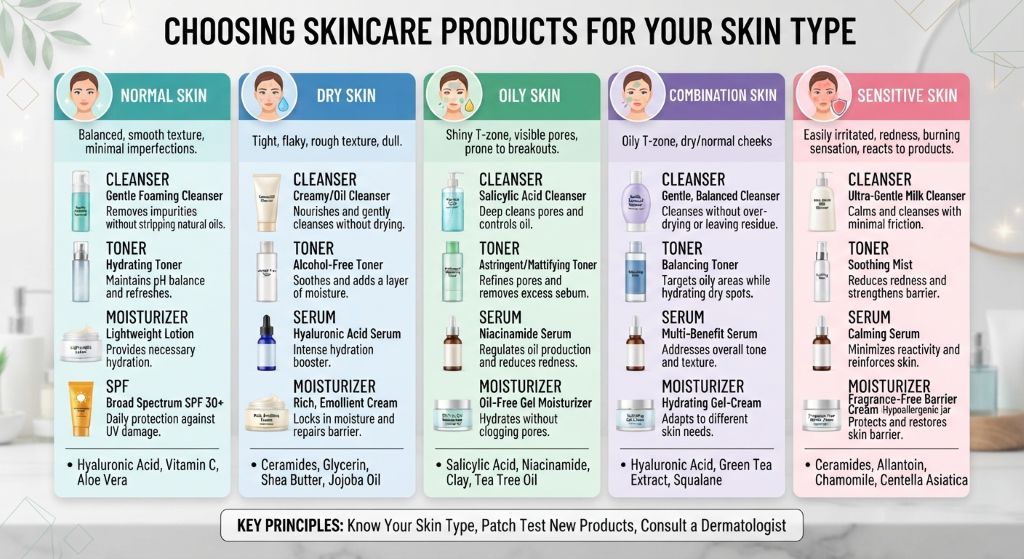
Once you know your skin type, ingredient selection becomes far more targeted. Different skin types respond best to very different formulations.
Dermatologists cited by Fashion Gone Rogue outline specific ingredient matches for each type. Dry skin benefits from lactic acid and shea butter, which add hydration alongside mild exfoliation. Oily skin responds well to hydroxy acids like salicylic or glycolic acid, along with hyaluronic acid and benzoyl peroxide, which help control excess sebum.
Sensitive skin needs a gentler ingredient profile than other types. The same source recommends soothing options like oatmeal, shea butter, and aloe vera for this category. These ingredients calm irritation rather than actively treating a specific concern.
Kiehl’s skincare guide adds a useful, broader list of well-tolerated ingredients. Glycerine, hyaluronic acid, vitamin C, vitamin E, vitamin B3, and retinol tend to suit most skin types reasonably well. However, even these common ingredients can cause problems if used incorrectly for your specific skin.
Beyond basic skin type, specific concerns should guide your product choices too. Kiehl’s guide advises looking beyond skin type toward concerns like acne, wrinkles, rosacea, or age spots. For example, choose an anti-aging moisturizer specifically if premature aging is your main concern, rather than a generic option.
Reading Ingredient Lists Correctly
Ingredient labels can feel intimidating, especially on longer lists. However, learning to read them properly protects your skin from unwanted reactions.
Kiehl’s guide offers a helpful formulation insight. The top five ingredients typically account for close to 80 percent of a product’s total formulation. Therefore, focus your attention on these leading ingredients rather than trying to analyze every single item listed.
A longer ingredient list does not automatically signal a lower-quality product. Fashion Gone Rogue notes that dermatologists often recommend not fearing longer lists, since medical-grade skincare naturally requires more ingredients to function properly. Shorter lists sometimes simply omit beneficial actives rather than avoiding harmful ones.
Certain ingredients deserve extra scrutiny regardless of your skin type. A skincare guide from Asbury Seminary’s resource page advises watching for common irritants like fragrance and dyes, particularly if you have sensitive skin. Products labeled fragrance-free and dye-free reduce this risk significantly.
Remember that marketing terms do not guarantee gentleness. Dr. Bruce Brod, a board-certified dermatologist quoted by the American Academy of Dermatology, states that even products labeled hypoallergenic, natural, or clean can still cause a skin reaction. Therefore, always evaluate the actual ingredient list rather than trusting label claims alone.
Why Patch Testing Matters Before Full Use
Even carefully chosen products can trigger unexpected reactions. Patch testing catches these problems before they affect your entire face.
The American Academy of Dermatology outlines a specific, reliable method for this process. Apply the product to a test spot twice daily for seven to ten days, choosing a quarter-sized area that won’t be rubbed or washed away, such as the underside of your arm.
This extended testing period matters more than a quick, single application. Dr. Brod explains that skincare ingredients, particularly certain preservatives, can trigger allergic contact dermatitis. This reaction causes skin to become red, itchy, and swollen, sometimes only after repeated exposure rather than immediate contact.
A faster testing approach also works for catching more obvious reactions. Kiehl’s guide suggests applying a product and watching for instant itchiness or redness, rejecting it immediately if any discomfort appears. Many brands now offer mini tester packaging specifically to support this kind of trial process.
Follow these steps for reliable patch testing before any new product joins your routine.
- Choose a small, discreet area like behind the ear or inner arm.
- Apply the normal amount you would use during regular application.
- Repeat this application twice daily for seven to ten full days.
- Watch closely for redness, itching, swelling, or unusual irritation.
- Stop immediately and rinse the area if any reaction appears.
- Wait the full testing period before applying it to your entire face.
Building Sun Protection Into Every Routine
Sunscreen deserves special attention among all skincare factors. Dermatologists consistently rank it as one of the most important daily habits.
A dermatologist-focused skincare guide states this priority clearly. Dermatologists emphasize using sunscreen every single day, regardless of the weather outside. This daily habit protects against premature aging, wrinkles, and skin cancer risk over the long term.
Application details matter as much as the product choice itself. The same guide recommends a broad-spectrum sunscreen with SPF 30 or higher, applied generously at least 15 minutes before sun exposure. Reapplication every two hours becomes especially important during sweating or swimming.
A separate dermatologist-recommended skincare guide reinforces this same standard. It states that broad-spectrum sunscreens with SPF 30 or higher are recommended for daily use, regardless of skin type. This universal recommendation applies whether your skin runs dry, oily, or sensitive.
Morning routines should account for how sunscreen interacts with other products. Augustinus Bader’s guide suggests choosing morning treatments that pair well with sunscreen, such as stable vitamin C, niacinamide, or azelaic acid. Avoiding excessive layering helps sunscreen perform its protective job effectively.
Assembling a Simple, Sustainable Routine
More products do not automatically mean better skincare results. A focused, consistent routine often outperforms an overloaded one.
A general skincare guide recommends starting simply. Begin with a basic routine of cleanser, moisturizer, and daily sunscreen before adding anything else. Gradually incorporate other products only as specific concerns arise, rather than starting with an elaborate routine from day one.
Introducing active ingredients requires similar restraint. Augustinus Bader’s guide advises applying just one main active ingredient at a time. For acne concerns, that might mean salicylic acid a few times weekly, or a retinoid on alternating nights, rather than combining several actives simultaneously.
This same principle applies to nighttime pigmentation treatment. The guide suggests choosing from options like a retinoid, vitamin C, azelaic acid, or gentle exfoliation, but explicitly not all at once. Layering too many actives together increases irritation risk without necessarily improving results.
Barrier damage represents a common consequence of routine overload. Augustinus Bader’s guide identifies over-cleansing and frequent exfoliation as common causes of this problem. Signs of barrier damage signal a need to simplify your routine rather than add further treatment products.
When to Seek Professional Guidance
Some skincare decisions benefit from expert input beyond general guidance. Recognizing these situations helps you avoid prolonged trial and error.
Kiehl’s guide recommends professional consultation for several specific situations. Consult a dermatologist regarding questions about your skin type, ongoing concerns, or how to develop a healthy long-term routine. This guidance proves especially valuable when standard advice does not seem to match your actual experience.
Persistent reactions to multiple products also warrant professional attention. Dr. Brod notes that when it becomes difficult to pinpoint which specific ingredient is causing a skin reaction, a board-certified dermatologist can help identify the exact cause. This diagnostic support saves considerable time compared to guessing through elimination alone.
Consider professional guidance in these specific circumstances.
- Uncertainty about your true skin type despite careful self-assessment
- Persistent irritation from multiple different products
- Specific medical concerns like rosacea, eczema, or severe acne
- Difficulty identifying which ingredient triggers your reactions
- Interest in medical-grade or prescription-strength treatment options
Conclusion
Choosing the right skincare products comes down to a few consistent factors. Identify your true skin type, match ingredients to your specific concerns, and always patch test before full use. Along with choosing suitable products, paying attention to your diet can also support healthier-looking skin, so consider these 6 foods for blemish-free skin as part of a balanced routine. Build sun protection into your daily routine, and keep your overall approach simple rather than overloaded. These habits protect your skin while still delivering real results.
A thoughtful approach to skincare pays off far more than chasing every new trend. Take time this week to properly assess your skin type and current routine. Start with these essential factors today, and build a skincare approach your skin will thank you for.
Frequently Asked Questions
How do I find out my true skin type?
Cleanse gently, then wait an hour without applying anything. Observe how your skin feels and looks in natural light.
Why is patch testing so important?
It reveals irritation or allergic reactions before you apply a product to your entire face.
Do I need sunscreen every day, even indoors?
Dermatologists recommend daily sunscreen regardless of weather. UV exposure still occurs even on cloudy days.
Should I introduce new active ingredients one at a time?
Yes, introducing one active at a time reduces irritation risk and helps you identify what works.
When should I see a dermatologist about my skincare?
See one if you’re unsure of your skin type or face persistent irritation from multiple products.