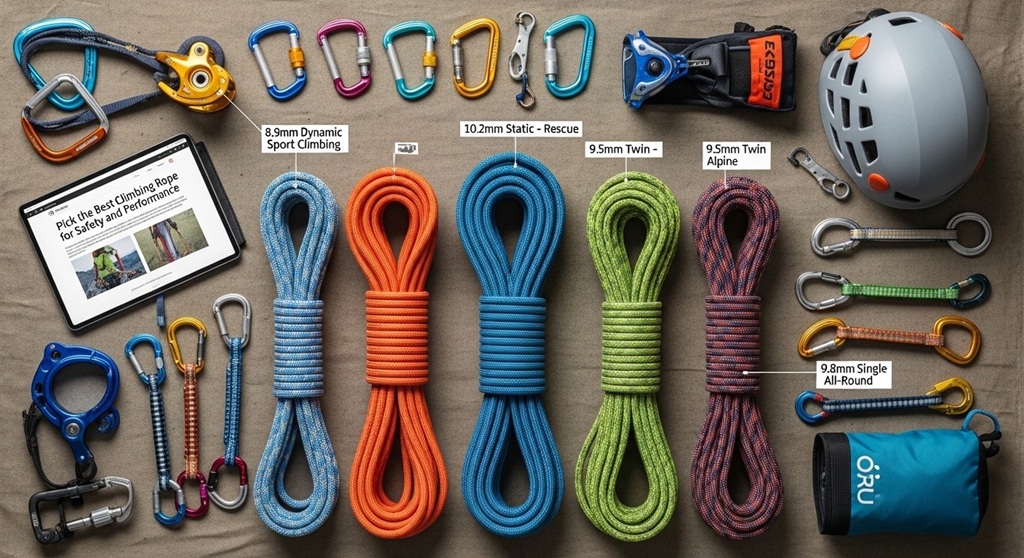
The best climbing rope in 2026 is a UIAA certified rope that matches your climbing style, offers verified fall ratings, and balances diameter, weight, and durability for your environment.
Choosing the right rope is not optional. It is the single most important safety decision you make as a climber. Your rope absorbs impact force, protects your partner, and determines how efficiently you climb. A wrong choice can mean faster wear, unsafe falls, and wasted money.
Modern ropes are lighter, stronger, and more specialized than ever. Brands now publish precise data on impact force, dynamic elongation, and sheath percentage. Independent lab tests by the UIAA show that certified single ropes must hold at least 5 UIAA falls under strict drop test conditions. That standard is your safety baseline.
This guide breaks down exactly how to choose a durable climbing rope for sport, trad, gym, or alpine use in 2026. No hype. Just clear data and practical guidance.
Why Does Choosing the Right Climbing Rope Matter So Much?
Short answer: Because your rope absorbs fall energy, reduces force on protection, and directly impacts safety and performance.
Problem: Many climbers buy based on price or brand popularity. They ignore fall rating, rope diameter, and sheath construction.
Agitation: A rope that is too thin wears out quickly. A rope that is too thick feels heavy and reduces clipping efficiency. A rope not designed for sharp edges may fail prematurely in alpine terrain.
Solution: Understand how ropes are tested and how specifications affect real-world climbing.
According to UIAA testing protocols, single ropes are tested with an 80 kg mass in repeated fall simulations with a fall factor of 1.77. This is harsher than most real climbing falls. If a rope passes, it earns certification. That is why buying a UIAA certified rope is non-negotiable.
Beyond certification, performance metrics include:
- Impact force (kN)
- Dynamic elongation (%)
- Static elongation (%)
- Sheath proportion (%)
- Number of UIAA falls
Each metric influences how safe and efficient your climbing experience will be.
What Types of Climbing Ropes Are Available in 2026?
Short answer: There are single ropes, half ropes, and twin ropes. Most sport and gym climbers use single ropes.
1. Single Ropes
Designed to be used alone. Marked with a “1” symbol. Ideal for sport climbing, gym climbing, and many trad routes.
2. Half Ropes
Used in pairs. Marked with “1/2”. Common in trad and alpine climbing. They reduce rope drag and offer redundancy.
3. Twin Ropes
Used together but clipped as one. Marked with “∞”. Lightweight. Often used in alpine terrain.
For most climbers in 2026, a single durable climbing rope between 9.4 mm and 9.8 mm offers the best balance of longevity and handling.
How Do You Choose the Right Rope Diameter?
Short answer: Thicker ropes last longer. Thinner ropes reduce weight but wear faster.
| Diameter | Best For | Durability | Weight |
|---|---|---|---|
| 8.9–9.2 mm | Projecting, redpointing | Lower | Light |
| 9.3–9.6 mm | Sport climbing | Medium | Balanced |
| 9.7–10.2 mm | Gym, top rope, heavy use | High | Heavier |
Case data from rope manufacturers shows thicker ropes often exceed 8–9 UIAA falls in testing, while ultra-thin ropes may rate closer to 5–6 falls. That difference impacts lifespan.
If you climb indoors frequently, prioritize a durable climbing rope in the 9.7 mm range. For outdoor sport routes, 9.4–9.6 mm is a strong middle ground.
What Makes a Rope Durable?
Short answer: Higher sheath percentage, tight weave construction, and abrasion-resistant treatment improve durability.
Ropes have two core components:
- Core (kern): Handles strength and energy absorption.
- Sheath (mantle): Protects the core from abrasion.
A rope with a higher sheath percentage (for example, 40% vs 35%) typically resists wear longer in rough environments.
Modern dry treatments also improve resistance to water and dirt. UIAA Water Repellent Standard requires ropes to absorb less than 5% water by weight. This matters in ice climbing and alpine routes.
If you want a reliable option with strong durability metrics, explore this durable climbing rope comparison guide to evaluate construction and performance benchmarks.
What Is a UIAA Certified Rope and Why Is It Important?
Short answer: A UIAA certified rope has passed independent lab testing for fall resistance, impact force, and safety standards.
The International Climbing and Mountaineering Federation (UIAA) sets global safety standards. Certification ensures:
- Minimum fall rating compliance
- Controlled maximum impact force
- Standardized elongation limits
- Consistent manufacturing quality
For single ropes, the maximum allowed impact force is 12 kN in testing. Lower impact force reduces stress on gear and the climber’s body.
Never buy a rope without UIAA labeling. It is the baseline for safe climbing practice.
How Long Should Your Climbing Rope Be?
Short answer: 60 m is standard. 70 m or 80 m is better for modern sport routes.
Route developers increasingly bolt longer pitches. Many outdoor sport climbs now exceed 30 meters. A 60 m rope may not safely lower from certain anchors.
Common lengths:
- 60 m – Gym and short outdoor routes
- 70 m – Most modern sport climbing
- 80 m – Long pitches and projecting
Always confirm route length before climbing. Rope length mistakes are preventable accidents.
How Does Impact Force Affect Safety?
Short answer: Lower impact force reduces stress on your body and protection.
Impact force is measured in kilonewtons (kN). It represents the maximum force transmitted during a fall in lab tests.
Example comparison:
- 8.5 kN – Softer catch, less gear stress
- 9.5–10 kN – Slightly firmer catch
Lower numbers are generally better, but very soft ropes may stretch more, which can be risky near ledges.
Balance is key. Look for ropes between 8.5–9.5 kN for single rope use.
When Should You Replace Your Climbing Rope?
Short answer: Replace after severe falls, visible core damage, or 1–5 years depending on use.
General manufacturer guidelines:
- Heavy weekly use: 1 year
- Regular weekend use: 2–3 years
- Occasional use: Up to 5 years
Immediate replacement signs:
- Soft or flat spots
- Core visible through sheath
- Glazing from friction
- Severe chemical exposure
No rope lasts forever. Retirement is part of safe climbing.
How Do You Maintain a Climbing Rope for Maximum Lifespan?
Short answer: Keep it clean, store it dry, and avoid sharp edges.
- Use a rope bag to prevent dirt contamination.
- Wash in lukewarm water when dirty.
- Air dry away from direct sunlight.
- Store loosely coiled in a cool place.
Dirt particles act like sandpaper inside the sheath. Proper maintenance extends lifespan significantly.
Conclusion: What Is the Smartest Rope Choice in 2026?
The smartest choice is simple. Buy a UIAA certified rope that matches your climbing style, offers balanced diameter, strong fall ratings, and proven durability metrics.
Do not chase trends. Focus on verified data. Look at fall ratings, impact force, sheath percentage, and water resistance. If you climb often, invest in a durable climbing rope built for abrasion resistance and long-term performance.
Your rope is your lifeline. Choose it with intention.
Ready to upgrade? Review tested rope comparisons and select a model that aligns with your climbing goals. Safety starts with informed decisions.
FAQ: Climbing Rope Buying Questions Answered
1. What diameter rope is best for beginners?
A 9.7–10 mm single rope is ideal. It lasts longer and handles well in belay devices.
2. Is a thinner rope less safe?
Not necessarily. Thin ropes are still safe if UIAA certified. They simply wear faster and require more attentive belaying.
3. How many falls can a rope hold?
Single ropes must hold at least 5 UIAA test falls. Many modern ropes exceed 7–9 falls in lab conditions.
4. Do I need a dry-treated rope?
Yes for alpine or ice climbing. For gym climbing, dry treatment is less critical.
5. Can I use a 60 m rope outdoors?
Yes, but many modern sport routes require 70 m. Always check route length first.
6. What is the difference between dynamic and static rope?
Dynamic ropes stretch to absorb falls. Static ropes are used for hauling and rappelling, not lead climbing.
7. How do I check if my rope is damaged?
Run it through your hands. Feel for soft spots, stiffness, or visible sheath damage.
Related Topic: How to Renovate an Apartment on a Budget: What Does It Really Mean?
Read Next: How to Choose the Right Materials for your Drive